Notebook or Phone Camera for a Noticing Walk?
Choose a notebook or phone camera for a noticing walk by the details you want to remember, then use a simple routine to keep looking closely.
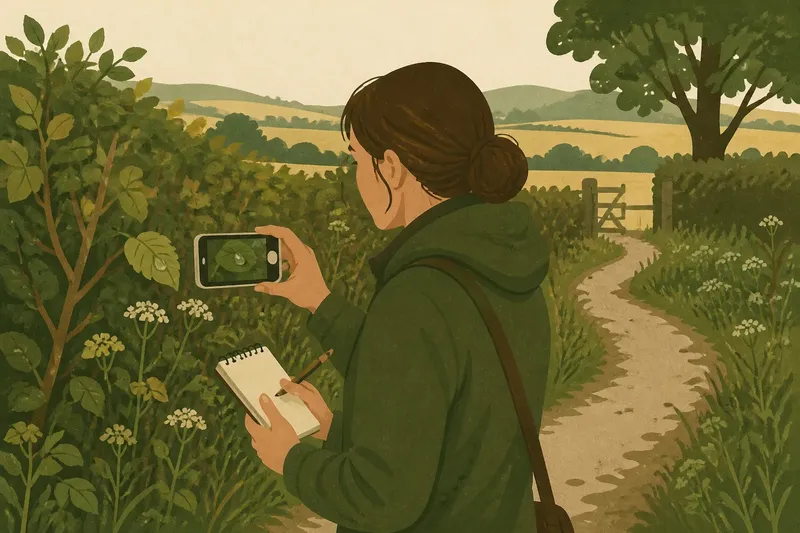
You pause beside a hedge on a noticing walk and spot a small detail: a leaf folded around a raindrop, or a bird calling from somewhere out of sight. A notebook or phone camera can help you remember it, but each keeps a different kind of record. The useful choice is the one that preserves the detail you want to return to without pulling you away from the walk.
What do you want to remember?
Before setting off, decide what counts as a worthwhile observation for you. It might be the shape and colour of a flower, the sound of water in a ditch, a change in the weather, or the way a path meets a field. You do not need a formal project; a small intention simply gives your attention somewhere to settle.
A photograph is strongest when the detail is visible and its appearance matters. A notebook is better suited to a sound, a sequence, a question, or a thought that would be hard to show in an image. Either can record more than one kind of detail, but starting with the main one makes the choice easier.
Try framing the decision as a question: if you looked at this record later, what would you most want it to bring back? If you would want to see the colour or arrangement again, reach for the camera. If you would want to recall what you heard, noticed, or wondered, make a note.
When does a phone camera suit the observation?
Use the camera when a subject has a clear visual feature that you can capture without disturbing it. A patch of lichen on a fence post, a cloud’s changing edge, or the pattern of seed heads against a field may all be easier to recognise in a picture than to describe later.
Hold the phone steady, check what is in the frame, and take one image that shows the detail in context. If the close-up is important, a second image can show where it sits: a flower beside a gate, for instance, is easier to place later than an isolated blur of petals. Avoid moving into fragile vegetation or getting close to wildlife simply to fill the screen.
A camera also makes comparisons possible. If you see the same bend in a stream on another walk, a picture can help you notice a change in water level, light, or plant growth. Treat the image as a visual cue, though, rather than a complete account: it cannot tell you what the stream sounded like or what you noticed just before the photograph.
There is a cost in attention. Opening an app, adjusting the frame, and checking the result can turn a short pause into a screen-focused task. Decide in advance that you will take a picture only when the detail is hard to remember by sight, then put the phone away and look again without it.
When is a notebook the better choice?
A notebook is useful when the observation involves more than appearance. Write down a bird’s call as a rhythm or a rough description, note the direction of the wind, or record how a smell changes near a stream. Such notes need not use specialist terms; “three thin whistles, then silence” may be more useful to you than an uncertain species name.
Writing can also hold a question open. You might note that one side of a hedge is damp while the other is dry, without needing to explain why. The written record keeps the comparison and your uncertainty together, instead of making a photograph seem like a complete answer.
Keep the method light. A small, sturdy notebook and a pencil are generally easier to use outdoors than a delicate sheet of paper and a pen that may stop writing in damp conditions. Write a few words rather than a full account, and leave space to add a thought later if the detail stays with you.
Like a shopping list tucked into a pocket, a notebook gives you a place to keep small reminders without needing to arrange them into a polished record. Its limitation is that written descriptions depend on what you notice and how you put it into words. If colour, shape, or a precise arrangement is the point, a short note may not bring it back as clearly as a picture.
How can you choose before you set off?
Make the decision from the kind of detail you expect to keep, not from the assumption that one tool is always better. A simple rule is: photograph what is chiefly visual; write what is chiefly sound, sequence, sensation, or thought. If the observation combines these, choose the part you are most likely to forget.
- Shape, colour, or pattern: take a photograph, then add a brief note if the setting matters.
- A call, rustle, or change in sound: write a description, since a still image cannot preserve it.
- A detail that changes over time: note what changed and when you noticed it; a photograph can provide a visual reference.
- A question you want to revisit: write the question beside the observation instead of guessing at an answer.
- A moment you want to keep moving through: make a quick note or take one picture, then return your attention to the place.
Say you reach a muddy gateway and notice tiny tracks crossing the path. If you want to compare their shape with marks you see later, a photograph that includes the surrounding ground may help; if you are more interested in the direction they travel and the question of what made them, a few written words may be more useful. Either choice preserves a different part of the same observation.
What should you do when you notice something?
Use a short routine so the record supports the walk rather than taking it over. First, stop somewhere that leaves the path clear and does not bring you too close to an animal or an unstable edge. Look at the subject directly before reaching for anything; this gives you a chance to notice context that a screen or page might otherwise crowd out.
- Name the detail silently. Ask yourself what caught your attention: colour, movement, sound, pattern, or a question.
- Choose the record that fits. Use the camera for visible form and the notebook for sound, sequence, and thought.
- Capture only the useful part. Frame one picture or write a short phrase that will make sense when you read it later.
- Add context if it could be lost. Note the kind of place or what was happening around the subject, without turning the moment into a long report.
- Put the tool away. Look once more, then continue walking rather than checking and editing the record.
For a photograph, context might be the nearby gate or bank. For a notebook entry, it might be “after rain, near the lower field path”. Keep identifying details modest, especially if the record includes other people or a place they use privately.
How can you combine notes and photographs?
You do not have to carry both methods for every observation. Pair them when each supplies something the other cannot: take a picture of a plant’s arrangement, then write down its scent or the way its leaves move in the breeze. A brief note can also explain why you took a picture, which is helpful if the image looks ordinary once you are home.
To keep a paired record easy to understand, make the connection obvious. Add a few identifying words beside the note, such as “yellow flower by the old gate”, or take the written note while the photograph is still on screen. Avoid relying on a complicated filing system; the point is to recall the observation, not to create a catalogue.
If carrying a notebook feels cumbersome, use the phone’s notes app for a few words or a short voice memo, provided it is suitable for the place and does not disturb others. If you prefer paper but want a picture, take the image and leave the written record for a later pause. The best combination is the one you will use without repeatedly interrupting your attention.
Which record suits common questions?
Can a phone camera record sounds?
A phone can make a sound recording where the setting and local rules permit it, but that is different from taking a photograph. A written description is quicker and lets you keep listening, while a recording may help if the exact sound is what you want to revisit.
What if I cannot name what I see?
Record what you can observe without guessing: colour, shape, movement, location, or the sound it makes. A photograph can preserve visible features, while a note can keep your question beside them for later identification.
How do I stop taking too many pictures?
Set a small personal limit before you start, such as photographing only details you would struggle to describe. The aim is not to collect every interesting view but to make a few records that help you remember what drew your attention.
Should I write notes while I am walking?
Stop in a safe, considerate place before writing, especially near traffic, cyclists, or uneven ground. A few words are enough; you can expand them after the walk if the observation still seems worth keeping.
How should you return to the record?
After the walk, look through your notes or images while the place is still familiar. Add a short explanation where a picture lacks context, or clarify a note that now seems too vague. Avoid filling gaps with guesses: mark uncertainty plainly so that a question remains a question.
Let the way you use the record shape your next choice. If a photograph helped you recall colour but left the sound and sequence behind, try writing those down next time. If a page of notes became hard to interpret, take a picture of the visible feature as well.
For a noticing walk, the notebook or phone camera is a means of paying attention, not a test of how much you can collect. Choose the tool that keeps the detail you care about, make the record brief, and leave enough of your attention free to notice what happens next.